


The precious metals complex remains under corrective pressure while attempting to establish baseline stabilization, with sellers maintaining near-term control in gold and silver while platinum shows early technical divergence.
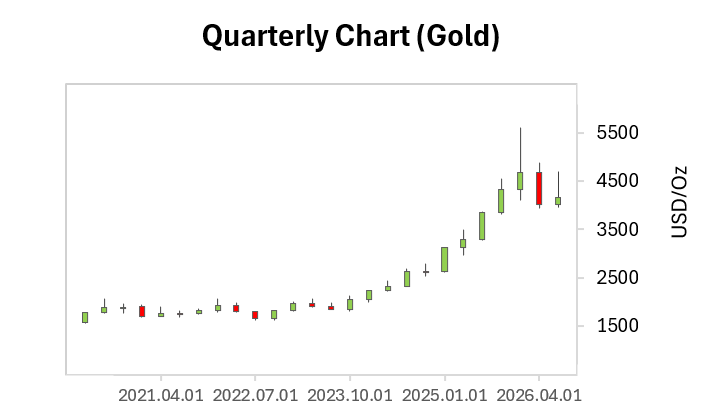
Gold enters Q4 facing heightened downward pressure and defensive testing following an aggressive upper wick rejection near the $4,600–$4,700 region. As short-term momentum gauges plunge from overbought extremes, price action is expected to remain under strain while retesting the crucial $3,900–$4,000 structural support zone. While near-term momentum favors sellers, gold’s long-term macro trend remains structurally intact, with deeper corrective dips expected to attract long-horizon institutional accumulation.
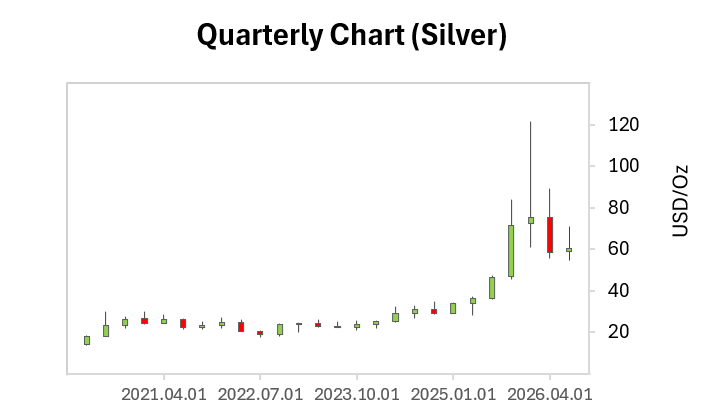
Silver remains locked under persistent corrective pressure following its unprecedented vertical surge toward historical highs near $120. Sellers continue to cap upside attempts near $65–$70 as speculative leverage unwinds, keeping price action vulnerable to range-bound retesting of the critical $55–$60 quarterly structural support zone. Although near-term cyclical gauges remain sloped downward, silver’s long-term trend strength indicators remain well above historical norms, positioning key support levels as crucial tests for institutional demand.
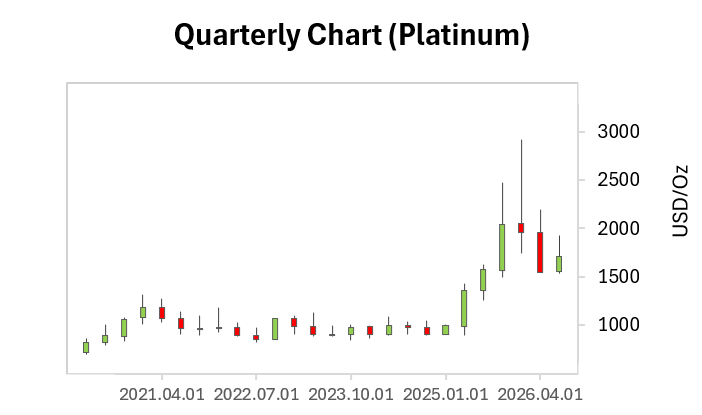
Platinum is entering a consolidation phase above structural support, exhibiting a unique momentum divergence as short-term fast cyclical gauges tick upward off their negative trough. Selling pressure is beginning to moderate following its post-spike retracement, with shorter upper wicks signaling decelerating downside velocity compared to gold and silver. Price action is anticipated to undergo range-bound consolidation between the $1,500–$1,600 support zone and $1,900 resistance while technical indicators finish resetting.
Overall, near-term momentum remains soft across the complex as prices navigate mid-cycle consolidations and reset overextended conditions throughout the October–December period. Market participants should expect continued defensive retesting and range-bound trading as the sector reacts to shifting central bank rate trajectories, geopolitical friction, year-end portfolio rebalancing, and industrial demand trends. Please refer to the individual reports for more details.
Quarterly Outlook (Q3 2026) for Gold (XAU/USD)
Bears Control Momentum as Corrective Pressure Mounts
Gold enters Q4 2026 facing heightened downward pressure and defensive testing following the close of the Q3 quarterly candle. A prominent upper wick rejection confirms aggressive selling and profit-taking near the $4,600–$4,700 region, leaving the market vulnerable to a deeper pullback. As short-term cyclical gauges plunge downward from overbought extremes, momentum favors sellers pressing for a retest of lower structural support levels. While institutional buyers previously defended the critical $3,900–$4,000 structural support zone, the immediate momentum suggests price will remain under defensive strain.
From a broader structural perspective, the multi-year macro trend remains intact, though the market is navigating a critical technical junction. As broader momentum gauges roll over, market dynamics remain finely balanced between an extended mid
cycle consolidation and a more prolonged macro pause until price resolves relative to key boundaries.
All in, we expect gold to experience persistent downward pressure and defensive retesting throughout Q4 2026. Price action is likely to skew toward testing the strength of the $3,900–$4,000 structural support zone as momentum gauges complete their reset.

Should deeper corrective dips materialize, they are expected to attract long-horizon institutional accumulation, establishing a cleaner technical foundation for the broader uptrend.
Quarterly Risk Notes
While long-term trend indicators show the broader bull market remains intact, short term momentum has plunged, keeping downside pressure active. If the nearest $3,900–$4,000 structural support fails, it would signal a transition into a broader consolidation toward the $3,550–$3,600 major support zone. Conversely, a decisive recovery above the $4,600–$4,700 resistance area is required to neutralize downward pressure.
Key Technical Levels
Support 1: ~$3,900 – $4,000 (quarterly structural support / demand zone)
Support 2: ~$3,550 – $3,600 (major prior consolidation area)
Resistance 1: ~$4,600 – $4,700 (upper wick rejection level / immediate resistance)
Resistance 2: ~$5,300 – $5,500 (next probable target region)
Macro Catalyst Themes for Q4 2026
- Geopolitical & Sovereign Debt Risks: Heightened geopolitical friction, expanding fiscal deficits, and sovereign debt concerns reinforcing gold as a primary risk hedge.
- Year-End Portfolio Rebalancing: Institutional asset reallocation and macro hedging against potential year-end equity and currency market volatility.
- Central Bank Policy & Yield Trajectory: Shifting interest rate expectations and real yield volatility directly influencing non-yielding asset demand.
- Official Sector Buying Resilience: Unyielding central bank reserve diversification absorbing supply and providing a durable structural support during pullbacks.
—————————————————
Quarter 2 Outlook for Silver (XAG/USD)
Bears Maintain Control as Silver Retests Structural Support
Silver enters Q4 2026 under persistent corrective pressure following the close of the Q3 quarterly candle. After an unprecedented vertical surge toward historical highs near $120, price action experienced a sharp pullback and is now attempting to stabilize near the critical $55–$60 quarterly structural support zone. Upper shadow rejections on recent rallies confirm that sellers continue to cap upside attempts near $65–$70, leaving the market vulnerable to defensive retesting as speculative leverage continues to unwind.
From a structural perspective, the market is balancing short-term weakness against long-term trend strength. While near-term momentum gauges continue to decline, confirming bears hold near-term control whereas long-term trend strength indicators remain well above historical norms. As broader momentum cools, market dynamics stay finely balanced between an extended mid-cycle consolidation and a more prolonged macro pause until price resolves relative to key technical boundaries.
All in, we expect silver to experience continued downward pressure and range-bound testing throughout Q4 2026. Price action is likely to remain constrained between the established $55–$60 structural support zone and the $65–$70 resistance area while momentum indicators complete their reset.

Should deeper corrective dips materialize, they will serve as an important test to determine whether long-horizon institutional demand re-emerges to defend the broader macro advance.
Quarterly Risk Notes
While long-term indicators show the broader bull market remains intact, short-term momentum continues sloping downward, keeping corrective pressure active. If the $55–$60 structural support fails, it would signal a broader consolidation toward the $45–$50 major support zone. Conversely, a decisive recovery above the $65–$70 resistance area is required to neutralize downward pressure.
Key Technical Levels
Support 1: ~$55 – $60 (nearest quarterly structural support)
Support 2: ~$45 – $50 (prior consolidation area)
Resistance 1: ~$65 – $70 (upper wick rejection level / immediate resistance area)
Resistance 2: ~$80 – $90 (secondary resistance area)
Catalyst Events to Watch:
- Industrial & Green Energy Demand: Global manufacturing activity, solar PV sector expansion, and electronics manufacturing directly influencing silver’s industrial consumption.
- Geopolitical & Sovereign Debt Risks: Heightened geopolitical friction, expanding fiscal deficits, and sovereign debt concerns reinforcing precious metals as a primary risk hedge.
- Year-End Portfolio Rebalancing: Institutional asset reallocation and macro hedging against potential year-end equity and currency market volatility.
—————————————————
Quarterly Outlook (Q3 2026) for Platinum (XPT/USD)
Short-Term Momentum Ticks Up as Support Holds
Platinum enters Q4 2026 in a consolidation phase above structural support following the close of the Q3 quarterly candle. After an unprecedented vertical acceleration toward historic peaks near $3,000 and a subsequent sharp retracement, price action is attempting to stabilize near the critical $1,500–$1,600 quarterly structural support zone. While an upper shadow remains on the latest candle, reflecting ongoing profit-taking on rallies near $1,850–$1,900, the upper wick is noticeably shorter than those observed in gold or silver, suggesting selling pressure is beginning to moderate.
From a technical standpoint, Platinum exhibits a unique momentum divergence relative to other precious metals. While medium-term trend indicators continue to cool, short-term fast cyclical gauges have ticked upward off their negative trough. This early upward hook in fast momentum indicates that short-term downside velocity is decelerating, keeping market dynamics balanced between a broader mid-cycle consolidation and an early stabilization attempt near key technical boundaries.
All in, we expect platinum to experience range-bound consolidation throughout Q4 2026. Price action is anticipated to oscillate between the established $1,500–$1,600 structural support zone and the $1,900 resistance area while technical indicators finish resetting.

With fast momentum turning constructive, holding above key support will serve as an essential test to confirm whether long-horizon industrial and institutional demand can stabilize the broader secular uptrend.
Quarterly Risk Notes
Primary downside risk stems from stop-loss liquidations within platinum’s characteristically thin physical liquidity conditions. Although fast momentum shows early signs of stabilizing, a breakdown below $1,500–$1,600 structural support risks triggering an amplified slide toward $1,250–$1,300. To validate this early momentum hook, buyers have to push price back above $1,900-$1,950 resistance.
Key Technical Levels
Support 1: ~$1,500 – $1,600 (nearest quarterly structural support)
Support 2: ~$1,250 – $1,300 (prior breakout area)
Resistance 1: ~$1,900 – $1,950 (immediate resistance)
Resistance 2: ~$2,150 – $2,200 (secondary resistance area)
Catalyst Events to Watch:
- Automotive & Industrial Demand Trends: Shifts in global auto manufacturing, hybrid catalyst requirements, and green hydrogen technology adoption directly impacting platinum consumption.
- Supply-Side Constraints & Mine Economics: Operational challenges, power-grid vulnerabilities, and rising extraction costs in primary mining regions restricting global supply.
- Global Interest Rates & Real Yields: Shifting monetary policy cycles and bond yield volatility directly influencing opportunity costs for non-yielding metals.
—————————————————
For more Bullion Insights, join GoldSilver Central’s Telegram channel or subscribe to our Bullion Insights Newsletter.